
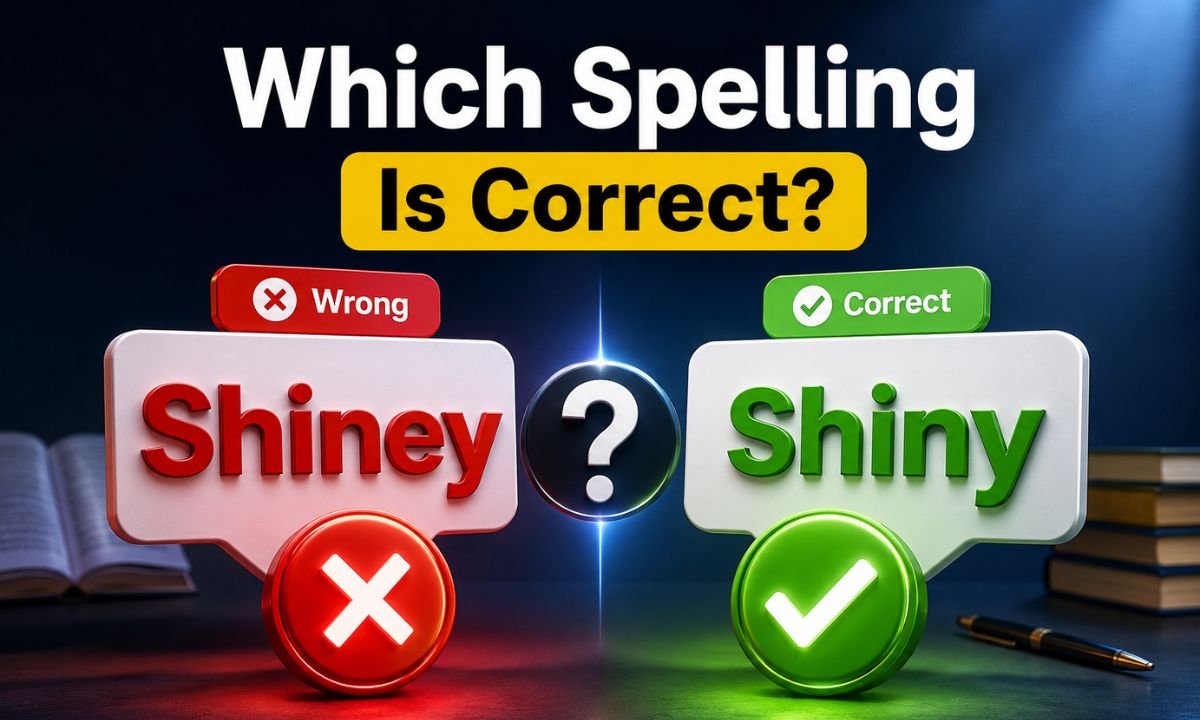
If you have ever paused mid sentence wondering whether to write “shiney” or “shiny,” you are not alone. The correct spelling is shiny. “Shiney” is a common misspelling that shows up constantly online, but no major dictionary recognizes it as a standard word.
This guide explains why “shiny” is correct, where the confusion comes from, how to pronounce it, and why you will still see “Shiney” used correctly in a few specific cases, like personal names and brand names.
Shiny or Shiney: The Correct Spelling Explained
Shiny is the standard English adjective meaning bright, glossy, or reflective. According to Merriam-Webster, shiny means “having a smooth glossy surface” or being “bright with the rays of the sun.” You will find this spelling in every major dictionary, including Merriam-Webster, Cambridge, and Oxford.
Shiney, on the other hand, is not listed as a standard adjective in any of these dictionaries. It is what linguists call an eye dialect spelling: a version of a word that looks like it should be correct because of how English usually forms adjectives, but that never became the accepted written form.
Quick Answer
| Question | Answer |
| Which spelling is correct? | Shiny |
| Is “shiney” a real word? | No, it is a common misspelling |
| Part of speech | Adjective |
| Pronunciation | SHY-nee (/ˈʃaɪni/) |
| Comparative / superlative | shinier / shiniest |
| Base word | shine (verb) |
Why Do People Write “Shiney” Instead of “Shiny”?
The mix-up is not random. English has several very common adjectives that end in “-ey,” such as “clayey,” “matey,” and informally “homey.” Because those words look natural with an “e” before the “y,” it is easy to assume “shine” should follow the same path when it becomes an adjective.
There is also a pronunciation factor at play. When people say the word out loud, the ending sounds like it could plausibly be spelled either way, since “-y” and “-ey” often sound identical in casual speech. Add in autocorrect inconsistencies and quick typing on phones, and “shiney” keeps circulating even though it never became the standard form.
The Spelling Rule Behind “Shiny”
Shiny comes from the verb shine. In English, when you form an adjective from a verb that ends in a silent “e,” that final “e” is usually dropped before adding a suffix that starts with a vowel, in this case “-y.”
You can see the same pattern in other common words:
- grease → greasy
- ice → icy
- haze → hazy
- spice → spicy
- grime → grimy
None of these words keep the “e” before adding “-y,” and “shine” follows the identical rule to become “shiny.”
Quick Tip: If you are ever unsure, think of “grease to greasy.” Since nobody writes “greasey,” there is no reason to write “shiney” either. The pattern is the same in both words.
Pronunciation of Shiny
Shiny is pronounced SHY-nee, written phonetically as /ˈʃaɪni/. The stress falls on the first syllable. The word rhymes with “tiny,” “whiny,” and “briny,” which is another useful memory trick, since none of those words are spelled with an extra “e” either.
Definition And Meaning Of Shiny
Shiny is an adjective with a primary meaning and a couple of useful extended meanings.
Primary meaning: Having a smooth, glossy, reflective surface that catches or gives off light. Examples: a shiny car, shiny shoes, shiny hair, a shiny coin.
Extended meanings:
- Something new, fresh, or exciting, often used in the phrase “shiny new,” as in “a shiny new phone” or “a shiny new app.” Here, “shiny” does not describe a literal glossy surface; it describes novelty and appeal.
- In casual or humorous usage, “oh, shiny!” is used as an exclamation when something catches a person’s attention, often something new or eye catching, regardless of whether it actually reflects light.
Synonyms And Related Words
Common synonyms for shiny include glossy, gleaming, lustrous, polished, sparkling, radiant, bright, and burnished. Related words that describe the opposite include dull, matte, and lackluster.
Origin And Etymology of Shiny
Shiny developed from the Old English verb “scīnan,” meaning to give off light or shine, which is the ancestor of the modern verb “shine.” Over time, English speakers added the adjective forming suffix “-y” to “shine,” dropping the silent “e” in the process, which produced “shiny.” This is a completely regular and predictable pattern in English word formation, not an exception you need to memorize separately.
Is It “Shiny” Or “Shiney” In British English?
There is no regional exception here. British English, American English, and Australian English all use the same spelling: shiny. If you search for “shiney or shiny UK” or “shiney or shiny Australia,” the answer does not change based on location. Major British dictionaries, including Cambridge and Oxford, list only “shiny” as the correct adjective.
This is different from words like “colour” versus “color” or “realise” versus “realize,” where British and American English genuinely diverge. Shiny is not one of those words. Anyone telling you “shiney” is the British spelling is simply repeating a common misconception.
When “Shiney” Is Actually Correct
Here is where things get genuinely interesting, and where a lot of search confusion comes from. While “shiney” is wrong as a spelling of the adjective, it does show up correctly in a few specific, unrelated contexts, because personal names and brand names do not have to follow standard spelling rules.
Shiney As A Personal Name
Shiney Ahuja is an Indian actor, born in 1973 in New Delhi, known for films including Hazaaron Khwaishein Aisi, Gangster, and Bhool Bhulaiyaa. In his case, “Shiney” is simply how his given name is spelled; it has nothing to do with the adjective meaning glossy or bright. Names are proper nouns, and proper nouns are not bound by the same spelling conventions as common adjectives.
Shiney Hiney As A Business Name
“Shiney Hiney Truck Wash” is the name used by a truck washing business. Business names are trademarks and branding choices, and companies frequently use stylized or nonstandard spelling on purpose to make a name more memorable or distinctive. This does not make “shiney” correct as a general spelling of the adjective; it simply means that particular business chose that spelling for its brand.
Note: If you are writing a school paper, a resume, a work email, or any formal content, always use “shiny.” Save nonstandard spellings like “Shiney” for cases where you are referring to an actual name, such as a person or a registered business.
“Shiny” in Pokémon: What Does “Shiny Pokémon” Mean?
If you searched for “shiney or shiny Pokémon,” you are likely asking about a specific gaming term, and the spelling question has a clean answer here too: it is officially Shiny Pokémon, never “Shiney Pokémon.”
A Shiny Pokémon is a rare, alternately colored version of a regular Pokémon, first introduced in Generation II with Pokémon Gold and Silver. Shiny Pokémon have the exact same stats and abilities as their normal counterparts; the only difference is their color palette, and in many games they also appear with a brief sparkle animation and sound effect when they enter battle.
Shiny Pokémon Odds
| Game Era | Base Odds of Encountering a Shiny |
| Generation II through V | 1 in 8,192 |
| Generation VI onward (main series) | 1 in 4,096 |
| Pokémon GO (standard rate) | Roughly 1 in 500 |
These odds can be improved through in-game methods such as the Shiny Charm item, chaining or catch combos, and certain breeding techniques, but the base rate never guarantees a Shiny after any fixed number of encounters. Each encounter is an independent chance, so a player could theoretically go tens of thousands of encounters without one, or find one on their very first try.
Popular Shiny Pokémon that players frequently search for and hunt include Shiny Charizard, Shiny Gengar, Shiny Umbreon, Shiny Sylveon, Shiny Rayquaza, Shiny Garchomp, Shiny Dragonite, and Shiny Eevee, along with its many Shiny Eeveelution forms. Fans who dedicate time to collecting these rare color variants are often called “shiny hunters.”
Other Common Phrases That Use “Shiny”
“Shiny Happy People” is the title of a well known 1991 song by the American rock band R.E.M. The correct spelling in the title follows standard English: “Shiny,” not “Shiney.”
“Oh, shiny” is a popular internet expression used to describe getting distracted by something new or eye catching, often used humorously to describe short attention spans.
“Shiny new” is a common collocation used to describe anything recently released or unused, from cars to gadgets to software, regardless of whether the object is literally glossy.
Shiny vs. Shiney: Side by Side Comparison
| Feature | Shiny | Shiney |
| Standard dictionary word | Yes | No |
| Correct in formal writing | Yes | No |
| Appears in Merriam-Webster, Cambridge, Oxford | Yes | No |
| Correct as an adjective | Yes | No |
| Can appear as part of a proper name or brand | Not applicable | Yes, in specific cases only |
| Recommended for everyday and professional use | Yes | No |
How to Remember the Correct Spelling
A few memory tricks make this easy to lock in permanently:
- Connect it to its base verb: shine becomes shiny, the same way grease becomes greasy.
- Use the rhyme test: shiny rhymes with tiny and whiny, neither of which has an extra “e.”
- Remember that autocorrect and spell check tools on phones and computers will flag “shiney” as incorrect, which is a useful built in reminder.
- If you picture a name like Shiney Ahuja or a business like Shiney Hiney, remember that those are exceptions tied to proper nouns, not the rule for the everyday adjective.
Common Mistakes to Avoid
- Do not write “shineyer” or “shineyest.” The correct comparative and superlative forms are shinier and shiniest.
- Do not assume British or Australian English uses a different spelling. They do not.
- Do not confuse “shiny” with “shinny,” which is an unrelated word referring to climbing by gripping with the hands and legs, as in “shinny up a tree.”
- Do not use “shiney” in resumes, essays, business writing, or anywhere formal, even if it sounds acceptable when spoken aloud.
Frequently Asked Questions
Is it spelled “shiney” or “shiny”?
It is spelled “shiny.” “Shiney” is a common misspelling not recognized by standard dictionaries.
Which is correct, shiney or shiny?
“Shiny” is correct. It follows the standard English rule of dropping the silent “e” from “shine” before adding “-y.”
Is “shiney” ever correct?
Only as part of a proper name or brand, such as the actor Shiney Ahuja or a business name. It is not correct as a general adjective.
How do you spell shiney or shiny in the UK?
The same way as in the US: “shiny.” British English does not use a different spelling for this word.
What does shiny mean?
Shiny means having a smooth, glossy, reflective surface, or more informally, something bright, new, or eye catching.
How do you pronounce shiny?
Shiny is pronounced SHY-nee, with the stress on the first syllable.
Is “Shiny Pokémon” the correct term, or “Shiney Pokémon”?
“Shiny Pokémon” is correct. This is the official term used across all Pokémon games and media.
What is the plural or other form of shiny?
As an adjective, shiny does not have a plural form. Its comparative and superlative forms are shinier and shiniest.
Is shiny an adjective or a verb?
Shiny is an adjective. The related verb is “shine,” as in “the sun shines.”
What is the origin of the word shiny?
Shiny comes from the Old English verb “scīnan,” meaning to give light, which evolved into the modern verb “shine,” and later took the adjective suffix “-y.”
Conclusion
When you are deciding between shiney or shiny, the standard English spelling is always shiny. It is the form used in every major dictionary, in gaming terms like Shiny Pokémon, and in everyday writing across the US, UK, and Australia. The only time “Shiney” is correct is when it refers to an actual proper noun, such as a person’s name or a business’s chosen brand spelling. For everything else, from a shiny car to a shiny new phone, stick with “shiny.